
In the intricate ecosystem of the modern U.S. stock market, few corporate activities generate as much fervent debate as the share buyback. To its proponents, a buyback—the process by which a company repurchases its own shares from the marketplace—is a supremely efficient mechanism for returning excess capital to shareholders, signaling confidence, and optimizing a firm’s financial structure. It is the embodiment of prudent capital stewardship.
To its detractors, the very same practice is a symbol of short-termism, a manipulative tool that inflates executive pay at the expense of long-term investment, worker wages, and innovation. It is viewed as financial engineering at its most pernicious, hollowing out the industrial base and exacerbating economic inequality.
This schism is not merely academic. In 2023, S&P 500 companies spent a staggering $922 billion on buybacks, nearing the record levels seen before the 2008 financial crisis and the 2022 market peak. This torrent of corporate spending has placed buybacks squarely in the crosshairs of politicians, regulators, academics, and investors, sparking a complex and often emotionally charged debate.
This article will dissect this heated controversy. We will explore the mechanics and stated justifications for buybacks, scrutinize the potent criticisms leveled against them, examine the evolving regulatory landscape, and ultimately seek to answer the central question: Are stock buybacks a legitimate instrument of value creation, or a fundamentally flawed practice that manipulates markets and harms the broader economy?
Part 1: The Mechanics and The Pro-Buyback Argument
Before adjudicating the debate, one must first understand the fundamental mechanics of a share buyback.
How a Buyback Works:
When a company generates profits, it has several options for deploying that capital:
- Reinvest in the business (R&D, new equipment, expansion).
- Acquire other companies.
- Pay dividends to shareholders.
- Hold as cash on the balance sheet.
- Repurchase its own shares.
When a company chooses option five, it uses its cash reserves (or sometimes debt) to buy back its shares from investors on the open market, much like any other purchaser. These repurchased shares are then retired or held as “treasury stock,” effectively ceasing to exist.
The Immediate Financial Impact:
The primary mathematical consequence is an increase in Earnings Per Share (EPS). EPS is a key metric calculated as (Net Income) / (Number of Outstanding Shares). By reducing the denominator (outstanding shares), EPS rises, all else being equal. A higher EPS often makes the stock appear more attractive to investors.
The Core Arguments in Favor of Buybacks:
Proponents, including many corporate executives, institutional investors, and free-market economists, advance several compelling arguments:
- Efficient Capital Return: The foundational argument is that when a company lacks sufficient high-return internal investment opportunities, returning excess cash to shareholders is the most disciplined course of action. Compared to dividends, buybacks offer shareholders flexibility; they can choose to sell shares and realize gains (a “self-dividend”) or hold onto their shares, increasing their proportional ownership stake without triggering a taxable event. Dividends, by contrast, are taxable income in the year they are received.
- Signaling Confidence: A buyback can be a powerful signal from management to the market. By committing capital to repurchase shares, executives are effectively saying, “We believe our stock is undervalued.” This signal can bolster market confidence and correct perceived mispricings more directly than verbal assurances.
- Tax Efficiency (Historically): For much of the modern buyback era, capital gains tax rates have been lower than income tax rates on dividends. This made buybacks a more tax-efficient way to return value to shareholders, as investors could defer taxes until they chose to sell their appreciated shares.
- Optimizing Capital Structure: Companies can use buybacks to adjust their debt-to-equity ratio. If a company’s balance sheet is overly laden with cash, it may be under-leveraged. Using cash (or even taking on low-cost debt) to buy back shares can create a more optimal capital structure, potentially lowering the company’s overall cost of capital and increasing its return on equity (ROE).
- Offsetting Dilution: Companies often issue new shares to compensate employees through stock options and awards. Buybacks are a common tool to prevent this from diluting the ownership percentage of existing shareholders. In this view, buybacks are not a reduction in shares but a maintenance of the status quo.
William L. McComb, the former CEO of Fifth & Pacific Companies (now Kate Spade), once articulated this view succinctly: “Buybacks are a legitimate and important tool for capital allocation… It’s about returning money to owners when you can’t create more value with it inside the company.”
Part 2: The Case Against Buybacks: Manipulation, Myopia, and Inequality
The critics of buybacks launch a multi-pronged assault on the practice, challenging its economic and social utility. Their arguments often extend beyond the boardroom to encompass broader societal concerns.
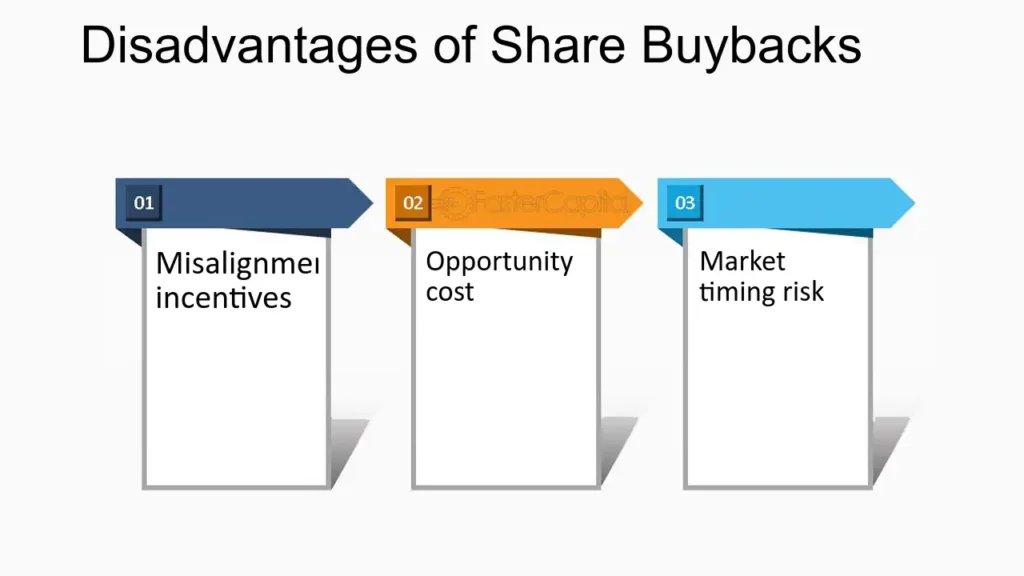
- The “Short-Termism” and Underinvestment Critique: This is the most potent criticism. The argument, championed by figures like Senator Elizabeth Warren and economist William Lazonick, is that the obsession with boosting EPS via buybacks comes at the direct expense of long-term corporate health. Money spent on buybacks is money not spent on:
- Research & Development (R&D): Cutting R&D budgets inflates short-term profits but can cripple a company’s future innovation pipeline.
- Capital Expenditures (CapEx): Deferred investment in new factories, technology, and equipment can erode a company’s competitive edge.
- Employee Compensation and Training: Funds that could be used to raise wages, improve benefits, or upskill the workforce are instead funneled to shareholders.
- The Executive Compensation Link and Potential for Manipulation: Critics argue that the link between EPS and executive pay creates a perverse incentive. Many executive compensation packages are heavily tied to metrics like EPS and stock price. By using company funds to artificially boost EPS, executives can directly inflate their own bonuses and stock awards, even if the underlying operational performance of the company is stagnant. This isn’t just returning value; it’s a potential mechanism for self-enrichment that can border on market manipulation.The practice of announcing a large buyback authorization to temporarily boost a sagging stock price is seen as a particularly cynical form of financial engineering, distracting from poor operational results.
- The Debt-Fueled Buyback and Financial Fragility: In an era of historically low interest rates, a troubling trend emerged: companies began taking on massive debt not to invest in growth, but to fund buybacks. This “leveraging up” can make a company dangerously vulnerable to economic downturns or rising interest rates. When the COVID-19 pandemic hit, several iconic companies that had engaged in heavy debt-funded buybacks (e.g., Boeing, ExxonMobil) were forced to lay off thousands and seek government aid, highlighting the systemic risks of this strategy.
- Exacerbating Economic Inequality: This is a broader societal critique. The benefits of buybacks flow overwhelmingly to the wealthiest segment of the population. According to the Federal Reserve, the top 10% of U.S. households own 89% of all stocks and mutual fund shares. When a company chooses a buyback over raising worker wages, it directly transfers wealth from labor to capital, widening the wealth gap. This has made buybacks a focal point in political discussions about inequality.
- The “Value Illusion”: Critics contend that buybacks often create a mirage of value rather than genuine growth. By reducing the share count, a company can show EPS growth even if its net income is flat or declining. This can mask underlying operational weaknesses and mislead investors who rely on EPS as a key health indicator.
Part 3: The Evolving Regulatory and Political Landscape
The debate over buybacks has moved from financial journals to the halls of Congress, leading to significant regulatory changes.
The SEC’s Safe Harbor: Rule 10b-18
The modern era of buybacks was ushered in by the Securities and Exchange Commission (SEC) in 1982 with the adoption of Rule 10b-18. This rule provides a “safe harbor” for companies against charges of stock manipulation, provided they adhere to four conditions:
- Manner of Purchase: All buys must be made through a single broker on any given day.
- Timing: Cannot purchase at the market open or during the last 30 minutes of trading (extended to 10 minutes for high-volume stocks).
- Price: Cannot pay a price higher than the highest independent bid or the last transaction price.
- Volume: Cannot purchase more than 25% of the average daily trading volume.
While designed to prevent manipulation, critics argue Rule 10b-18 effectively sanctions and facilitates a massive, continuous corporate bid in the market, insulating a practice that would be suspect for any other large market participant.
The New 1% Excise Tax: The IRA’s Impact
A major shift occurred with the passage of the Inflation Reduction Act (IRA) of 2022. The law instituted a 1% excise tax on corporate stock buybacks, effective January 1, 2023. This was a direct political response to the perception that buybacks were a loophole for corporate excess.
The intended effect is twofold:
- Raise Revenue: To help fund the legislation’s climate and healthcare initiatives.
- Create a Disincentive: To make buybacks slightly less attractive, theoretically nudging companies toward alternative uses of capital, such as dividends or investment.
Early data suggests the tax has not dramatically curbed the aggregate volume of buybacks, given their sheer scale. However, it has increased the cost of capital allocation and sparked complex tax planning within corporate treasury departments. Some companies, like PepsiCo, have publicly stated they will shift slightly more toward dividends as a result, indicating the tax is having its intended behavioral effect at the margins.
Political Scrutiny and Proposed Legislation
The political pressure is unlikely to subside. Proposals from progressive lawmakers have gone much further, including:
- The Reward Work Act: Sponsored by Senator Bernie Sanders, this bill would, among other things, ban all open-market stock buybacks.
- Linking Buybacks to Worker Benefits: Other proposals would require companies to pay workers a living wage and offer specific benefits before being permitted to execute buybacks.
While these more radical bills lack the votes to pass currently, they frame the political narrative and keep the issue at the forefront of economic policy debates.
Read more: U.S. GDP Growth Slows: Is the Economy Heading for a Soft Landing?
Part 4: A Nuanced Verdict: Context is Everything
After weighing the evidence, a clear, binary verdict—”good” or “bad”—proves elusive. The truth is that the merit of a buyback is almost entirely dependent on context.
When Buybacks Are Likely Value-Creating:
- Genuine Undervaluation: When a company’s management and board have a rigorous, well-justified belief that the stock is significantly undervalued, and the buyback is the most attractive investment available.
- Sustainable Capital Structure Optimization: When a company with a rock-solid balance sheet and strong, stable cash flows uses excess cash (not debt) to return capital to shareholders after fulfilling all investment needs.
- A Part of a Broader, Disciplined Strategy: When the buyback is one element of a coherent capital allocation framework that also includes robust R&D, CapEx, and fair worker compensation. Apple, despite its massive buyback program, also continues to invest heavily in R&D and maintains a colossal cash reserve.
When Buybacks Are Likely Value-Destructive or Problematic:
- Sacrificing Long-Term Investment: When a company cuts productive investment in R&D, maintenance, or growth initiatives to fund repurchases.
- Fueled by Dangerous Debt: When a company leverages its balance sheet to buy back shares, increasing financial risk for shareholders and employees.
- Driven by Executive Compensation Motives: When the primary impetus appears to be hitting EPS targets to trigger executive bonuses, rather than a genuine belief in undervaluation.
- Lack of Transparency: When companies are not clear with investors about their long-term capital allocation strategy and use buybacks as a opaque tool to manage EPS.
The critical takeaway is that the motive and financial context matter more than the act itself. A buyback from a mature, cash-rich tech company like Microsoft is fundamentally different from a buyback from a capital-intensive industrial firm taking on debt in a cyclical downturn.
Conclusion: Beyond the Heated Rhetoric
The debate over U.S. stock buybacks is a proxy for a larger conflict about the very purpose of the corporation. Is it solely to maximize shareholder value in the shortest possible term? Or is it to create sustainable, long-term value for all stakeholders, including employees, customers, and communities?
Buybacks are not inherently evil, nor are they a panacea. They are a financial tool—powerful and neutral in isolation. The problem lies in their application. The decades-long trend toward prioritizing buybacks and dividends over wages and investment reflects a broader shift in corporate philosophy and power dynamics.
Moving forward, the solution is not necessarily an outright ban, which could have unintended consequences and stifle legitimate capital return. Instead, the focus should be on:
- Enhancing Transparency and Accountability: Requiring more detailed disclosures in SEC filings on the rationale for buybacks, their link to executive compensation, and the board’s analysis of alternative uses for the capital.
- Reforming Executive Compensation: De-linking pay from short-term metrics like EPS and tying it more closely to long-term, operational performance indicators and investments.
- Encouraging a Broader View of Corporate Purpose: Pushing boards and management to adopt a true multi-stakeholder approach that balances the legitimate interests of shareholders with those of workers and the long-term health of the enterprise.
The heated debate over buybacks is ultimately a healthy one. It forces a necessary conversation about capital, responsibility, and the kind of economy we want to build. The challenge is to move beyond the simplistic rhetoric and craft a system where the tool of buybacks serves the company, and the economy, as a whole—not just a narrow set of short-term interests.
Read more: Labor Market Resilience: Analyzing the U.S. Jobs Report and Wage Growth Trends
Frequently Asked Questions (FAQ)
Q1: What is the difference between a stock buyback and a dividend?
Both return capital to shareholders, but in different ways. A dividend is a direct cash payment to all shareholders on a per-share basis, and it is typically paid quarterly. It provides immediate, taxable income. A buyback returns value indirectly by reducing the number of shares outstanding, which (theoretically) increases the value of each remaining share. It offers tax deferral, as shareholders only incur capital gains tax when they sell their appreciated shares.
Q2: Don’t buybacks boost the stock price? Is that manipulation?
Buybacks can boost the stock price through two channels: 1) The simple mechanics of increased demand from the company itself, and 2) The increased Earnings Per Share (EPS). Whether this is “manipulation” depends on intent. If the sole goal is to artificially inflate the price to hit short-term targets or enrich executives, it can be viewed as manipulative. If it is a sincere belief in undervaluation and part of a prudent capital plan, it is considered a legitimate market activity. The SEC’s Rule 10b-18 attempts to draw a legal line between the two.
Q3: I’ve heard buybacks hurt workers. Is that true?
This is a central point of contention. Critics argue that money spent on buybacks is money not spent on higher wages, better benefits, or more hiring. There are documented cases of companies announcing massive buyback programs while simultaneously laying off workers or freezing wages, which lends credence to this view. However, proponents argue that a healthy, profitable company that efficiently returns capital to shareholders is better positioned to provide stable employment in the long run. The evidence is mixed but suggests that in specific cases, the trade-off is very real.
Q4: Why did the government implement a 1% tax on buybacks?
The 1% excise tax, introduced in the Inflation Reduction Act of 2022, was primarily a political and fiscal decision. Lawmakers critical of buybacks saw it as a way to both raise revenue and create a small disincentive for the practice, hoping to nudge corporations toward other uses of capital, like investment or dividends.
Q5: Are there any companies that do buybacks “the right way”?
Many investors point to companies like Berkshire Hathaway and Apple as examples of relatively disciplined approaches. Berkshire, led by Warren Buffett, has always stated it will only buy back its own shares when they are trading below a conservative estimate of their intrinsic value. Apple executes enormous buybacks but does so from a position of immense, sustained cash generation and while continuing to invest heavily in innovation and its supply chain. The key is a clear, value-based rationale rather than a reflexive or short-term-focused program.
Q6: As an individual investor, how should I view a company’s buyback announcement?
Be analytical, not celebratory. Don’t just see a buyback announcement as a automatic “buy” signal. Ask critical questions:
- Is the company underinvesting in its future? Check if R&D or CapEx is declining as a percentage of revenue.
- Is it taking on debt to fund the buyback? Examine the company’s debt levels and interest coverage.
- Is the stock truly undervalued? Look at valuation metrics like P/E ratio compared to its history and peers.
- What is the track record? Has past buyback activity created long-term value or simply boosted the stock temporarily?